
If you are looking for reliable Southwest Florida Property Maintenance, you have come to the right place.
The Comprehensive Operational Manual for Homeowners, Vacation Rental Hosts, and Seasonal Residents across Lee, Fort Collier, and Charlotte Counties.
Table of Contents
Understanding the SWFL Coastal Microclimate for Southwest Florida Property Maintenance
Southwest Florida (SWFL) presents one of the most demanding environmental settings for residential architecture in North America. Specifically, properties located in Lee and Collier countiespa rticularly those along Cape Coral’s 400+ miles of saltwater and freshwater canals are subject to a unique mix of high environmental stressors. Therefore, effective Southwest Florida Property Maintenance starts with understanding how the local salt air and humidity interact with your building materials.
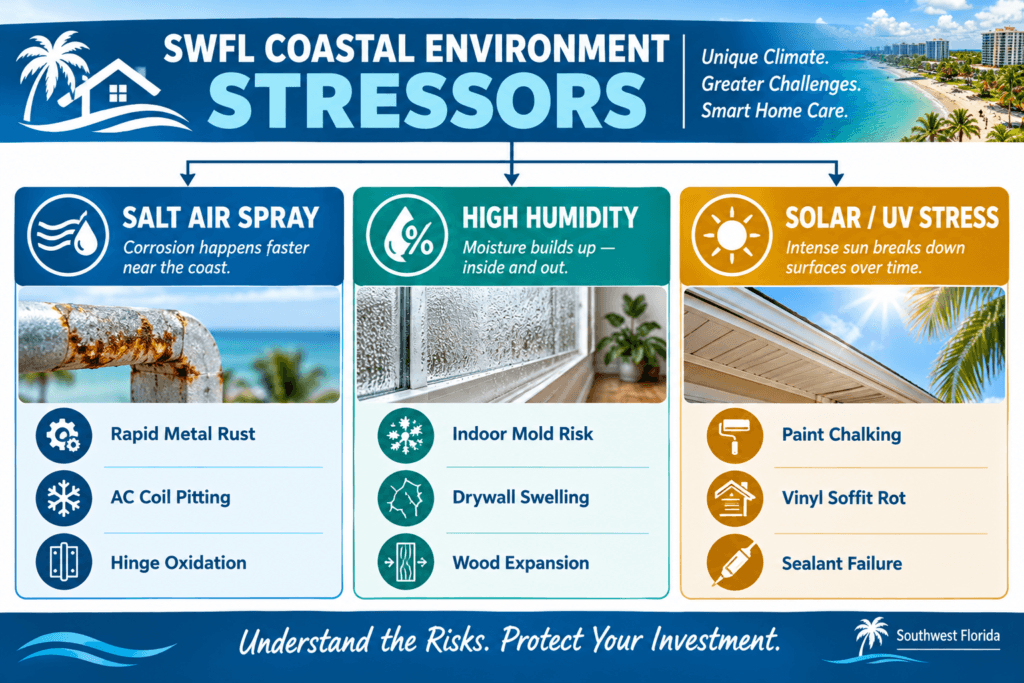
The Salt Air Radius & Atmospheric Chloride Corrosion
Furthermore, salt air is not just for beach houses. As a result, tiny salt bits blow several miles inland every day via daily sea breezes, settling continuously on building envelopes.
Specifically, the 0 to 1-Mile Zone (Direct Waterfront) is an extreme corrosion zone. Consequently, unprotected ferrous metals degrade up to 10 times faster than in inland environments. Copper air conditioner condenser coils, stainless steel hardware, and aluminum lanais suffer accelerated galvanic oxidation.
Furthermore, the 1 to 5-Mile Zone (Canal Networks & Estuaries) is a high corrosion zone. Here, Salt haze combines with morning dew to form an acidic condensation layer on exterior surfaces, degrading paint binders and pitting window framing.
The Thermal & Relative Humidity Dynamic
Meanwhile, SWFL experiences extended periods where outdoor relative humidity (RH) exceeds 85% with ambient temperatures hovering between 88°F and 95°F. As a Consequence, this creates a strong moisture push: wet outdoor air tries to move inside toward cool, air-conditioned indoor spaces.
Additionally, if a building’s vapor barrier or HVAC system is compromised, this moisture settles within wall cavities. Consequently, it leads to hidden structural rot, insulation degradation, and rapid microbial growth.
Exterior Building Envelope & Southwest Florida Property Maintenance
First and foremost, maintaining the structural shell (roof, soffits, stucco, and drainage) is your first line of defense against tropical storms and humidity penetration.
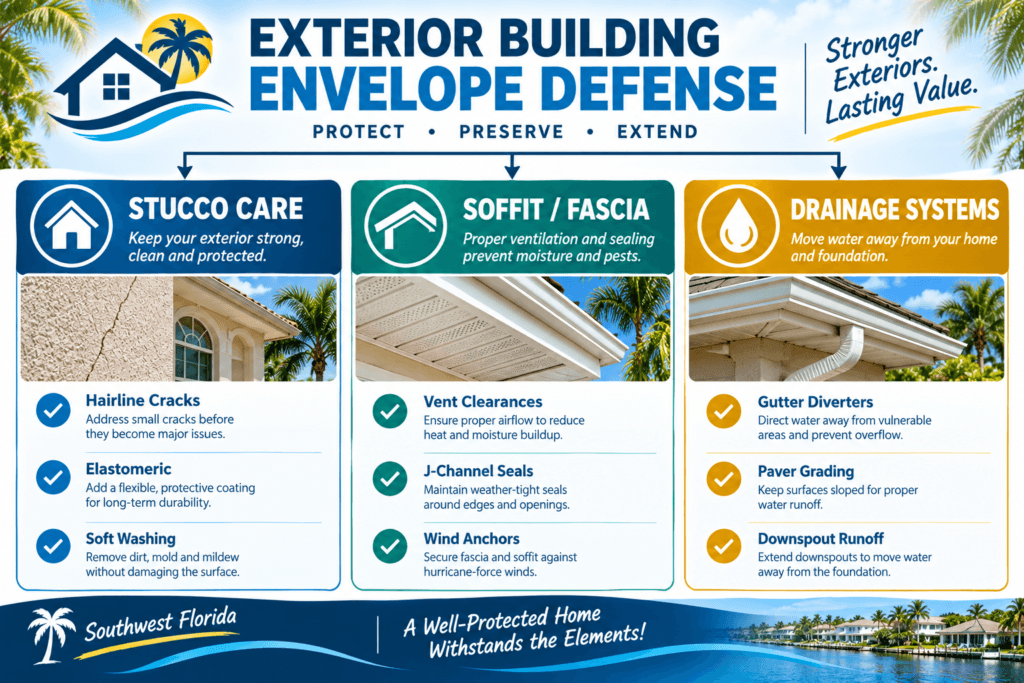
Stucco Inspection, Crack Repair & Soft Washing for Cape Coral Property Maintenance
Generally speaking, most homes in Cape Coral and Fort Myers are constructed using Concrete Masonry Units (CMU) finished with an exterior Portland-cement stucco system. However, stucco is naturally porous and therefore prone to thermal expansion cracking.
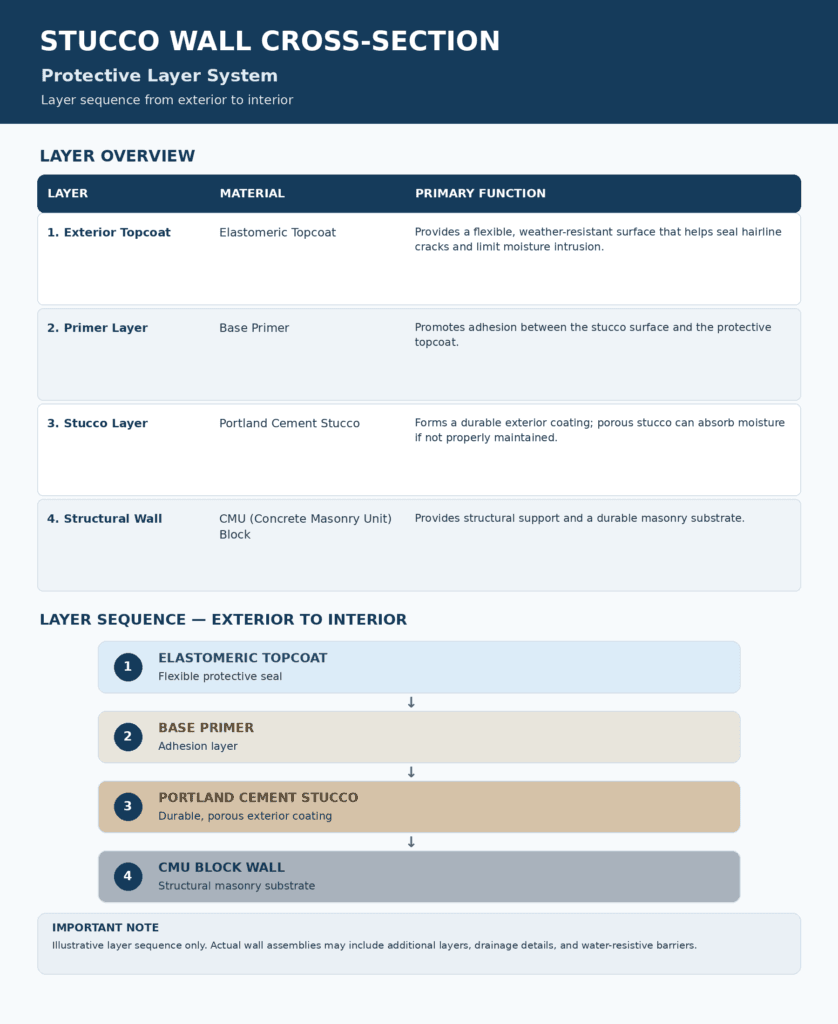
Southwest Florida maintenance tip: Before applying an elastomeric coating, repair cracks and address any underlying moisture problems. Confirm that the coating is compatible with the existing stucco system and allows appropriate moisture vapor transmission.
Diagnostic Crack Assessment:
Hairline Cracks (< 1/16″): Non-structural shrinkage cracks. Must be sealed before rainy season to prevent wind-driven rain from saturating the block underneath.
Structural Fractures (> 1/8″): Indicates settling, header stress, or ground shift. Requires mechanical v-grooving and structural masonry caulk prior to repainting.
The Soft-Washing Protocol vs. High-Pressure Blasting:
High-pressure power washing (above 2,000 PSI) can strip the protective paint film off stucco, blast water past window weatherstripping, and force moisture deep into the masonry.
Recommended Method: Instead, use Soft Washing utilizing a low-pressure chemical applicator (under 300 PSI).
Cleaning Solution Mix: Specifically, apply a diluted sodium hypochlorite solution (1.5% to 2.0% active strength) blended with a surfactant.
Dwell Time: Next, allow 10 to 15 minutes of dwell time to eradicate organic spores (Gloeocapsa magma algae and black mold) down to the root. Afterward, complete a thorough low-pressure freshwater rinse.
Soffit, Fascia & Attic Ventilation Dynamics
Specifically, roof soffits serve two critical functions: allowing cool air to draw into the attic space to displace super-heated air (which can reach 140°F+ in July) and preventing wind-driven rain entry during tropical storms.
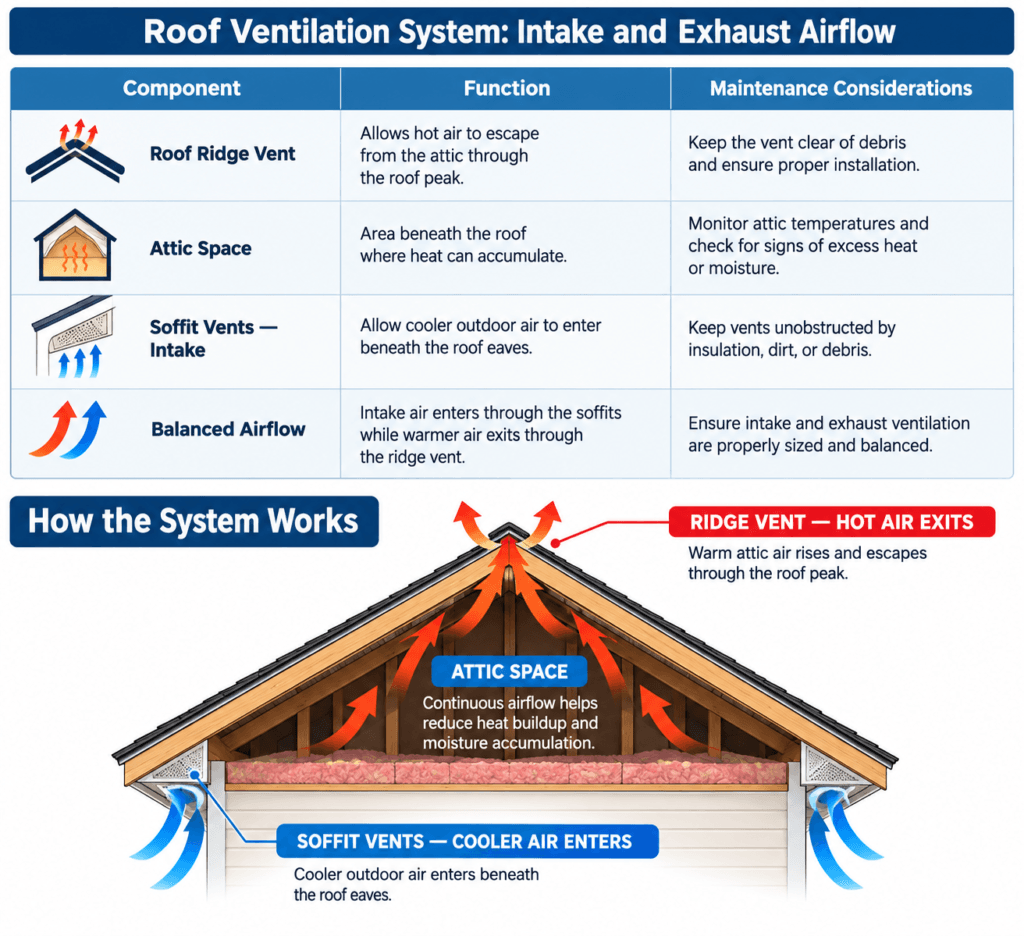
Outdoor air enters through vents under the eaves.
Always keep soffit vents clear and ensure the ridge vent and intake vents work together. However, an attic temperature below 110°F is not guaranteed by ventilation alone; instead, actual temperatures depend on outdoor conditions, insulation, air sealing, and ventilation design.
Aluminum vs. Vinyl Soffit Panels: For instance, vinyl panels can warp under extreme heat if not installed with proper thermal expansion clearance in the receiving J-channels. Conversely, aluminum panels offer higher wind resistance, although they require stainless steel fasteners to prevent rust-staining along the fascia.
Intake Clearance Check: Therefore, inspect soffit vents annually to ensure attic insulation hasn’t shifted and blocked air intake pathways. Otherwise, blocked vents raise home cooling costs and trap moisture inside roof framing.
Pest Proofing: In addition, ensure all soffit end-caps and fascia returns are completely sealed. Otherwise, small gaps allow rodents, bats, and mud daubers to enter the attic space.
Gutter Routing & Foundation Grading
For instance, SWFL storms can drop 2 to 4 inches of rain per hour. As a result, without adequate perimeter drainage, water pooling against concrete foundations can cause slab settling, floor tile cracking, and subterranean termite intrusion.
Downspout Discharge: Therefore, all downspouts must extend at least 3 to 5 feet away from the foundation wall or empty directly into subsurface drainage pipes routed toward the canal or street gutter.
Splash Block Inspection: Additionally, verify that splash blocks or pop-up emitters are clear of lawn clippings, mulch, and invasive roots.
HVAC, Humidity Control & SWFL Property Maintenance
Above all, proper HVAC care is a critical cornerstone of any Southwest Florida Property Maintenance plan to prevent indoor mold growth. Indeed, your HVAC system is not merely an air cooler; rather, in Florida, it is fundamentally a dehumidification engine.
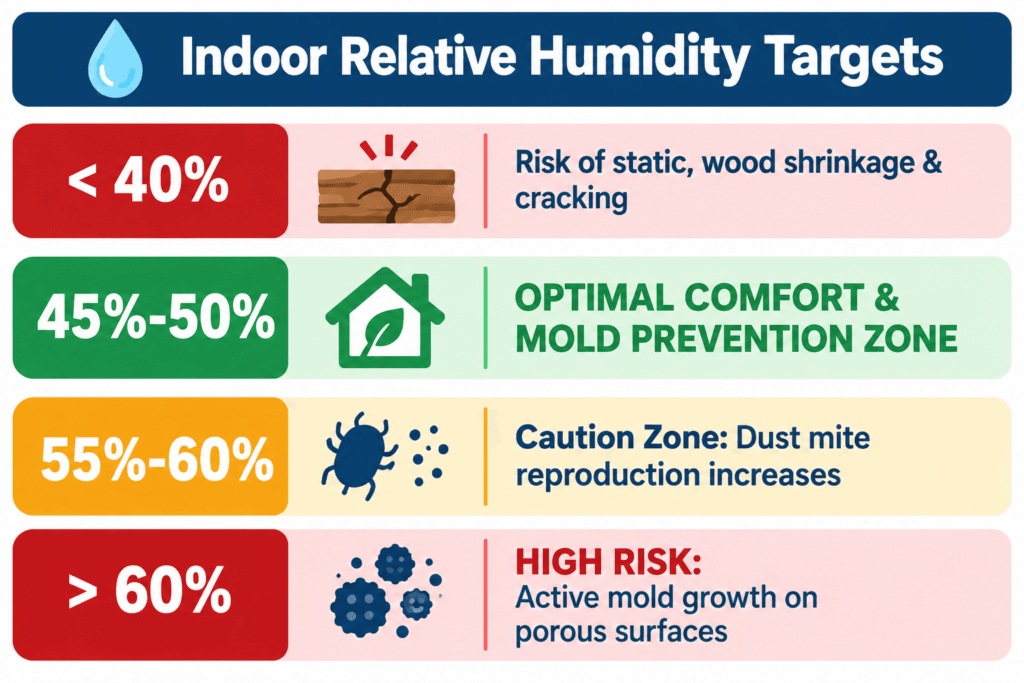
Take steps to lower humidity and investigate moisture problems.
Southwest Florida homeowner tip: Aim to keep indoor relative humidity below 60%, ideally around 45%–50% when practical. Mold risk also depends on surface temperature, leaks, and how long materials remain damp.
Thermostat Configuration for Occupied vs. Vacant Homes
Occupied Protocol:
Set cooling between 72°F and 75°F.
Keep the thermostat fan setting on AUTO. Setting the fan to ON causes continuous blower operation, which re-evaporates water droplets from the wet cooling coil back into the home’s airstream before they can drain away.
Vacant / Seasonal Protocol (Snowbirds & Rental Gaps):
Meanwhile, set cooling between 76°F and 78°F.
Above all, do NOT shut off the AC system in the summer. Shutting off the system will cause indoor relative humidity to rise above 80% within 48 hours, triggering rapid mold growth across cabinets, furniture, and drywall.
Smart Dehumidification Systems: Utilize a smart thermostat with an integrated humidistat override (such as ecobee or Honeywell Pro) programmed to run cooling cycles whenever relative humidity exceeds 55%, regardless of indoor air temperature.
Southwest Florida Property Maintenance for Condensate Line & Overflow Prevention
Consequently, the primary cause of emergency HVAC shutdowns… is a clogged condensate drain line. As the cooling coil pulls gallons of moisture from the air daily, algae and biological slime thrive inside the dark 3/4-inch PVC drain pipe.
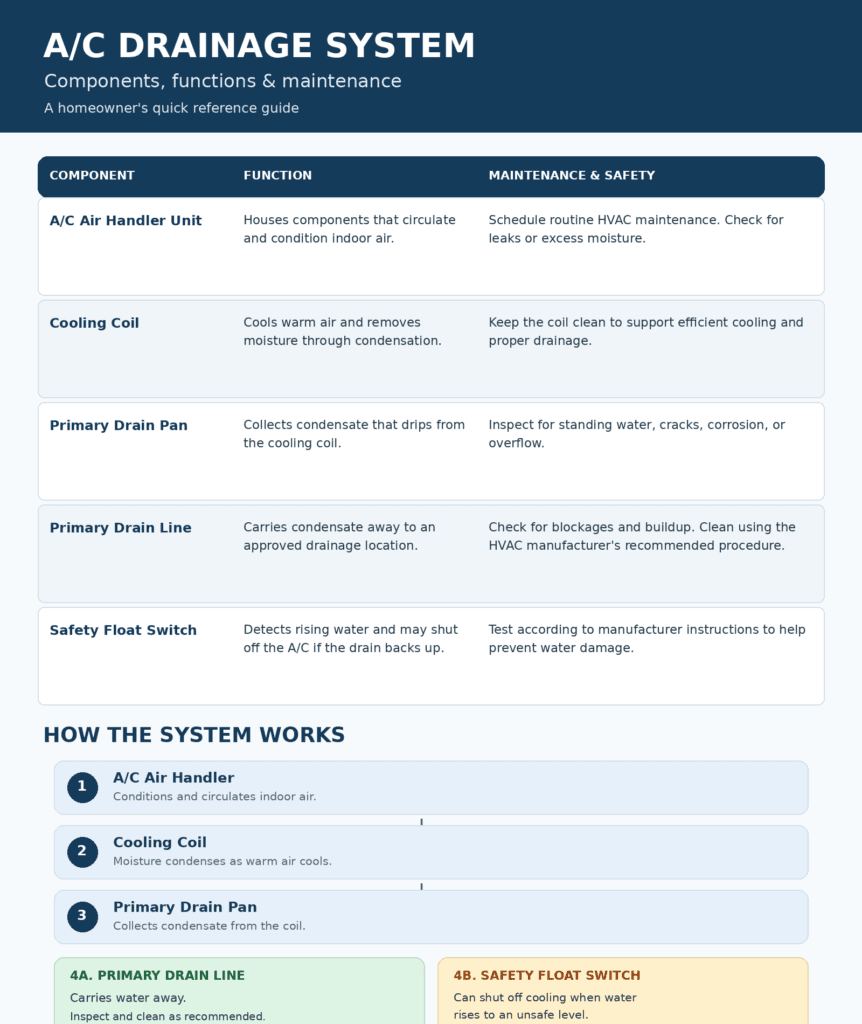
Important maintenance tip: Some homeowners use white vinegar for routine drain-line maintenance, but compatibility and recommended quantities vary by system. Check your HVAC manufacturer’s guidance or ask your technician before pouring anything into the drain line. Never mix vinegar with bleach or other drain-cleaning chemicals.
Step-by-Step Condensate Line Service Procedure:
Locate the PVC T-trap access point near the indoor air handler unit.
Remove the T-cap cover.
Slowly pour 1 cup of plain white distilled vinegar into the line. (Avoid concentrated bleach if your system drains into a yard or landscaping, as chlorine fumes can degrade internal coil solder and kill lawn grass at the discharge outlet).
Allow it to sit for 30 minutes to dissolve biological buildup.
Flush with 1 quart of warm tap water and verify clear flow at the exterior discharge pipe.
Float Switch Test: Lift the cap on the secondary safety float switch to verify that the mechanical switch cuts power to the thermostat when water rises.
Drywall, Paint & Interior Finish Restoration for SWFL Property Maintenance
High interior humidity and foundation expansion often create stress cracks in interior drywall, while busy vacation rentals suffer frequent luggage scuffs and door handle impacts. Reliable Southwest Florida Property Maintenance also includes repairing interior stress cracks and refreshing paint after heavy rental turnover.
Drywall Patching & Texture Matching (Orange Peel vs. Knockdown)
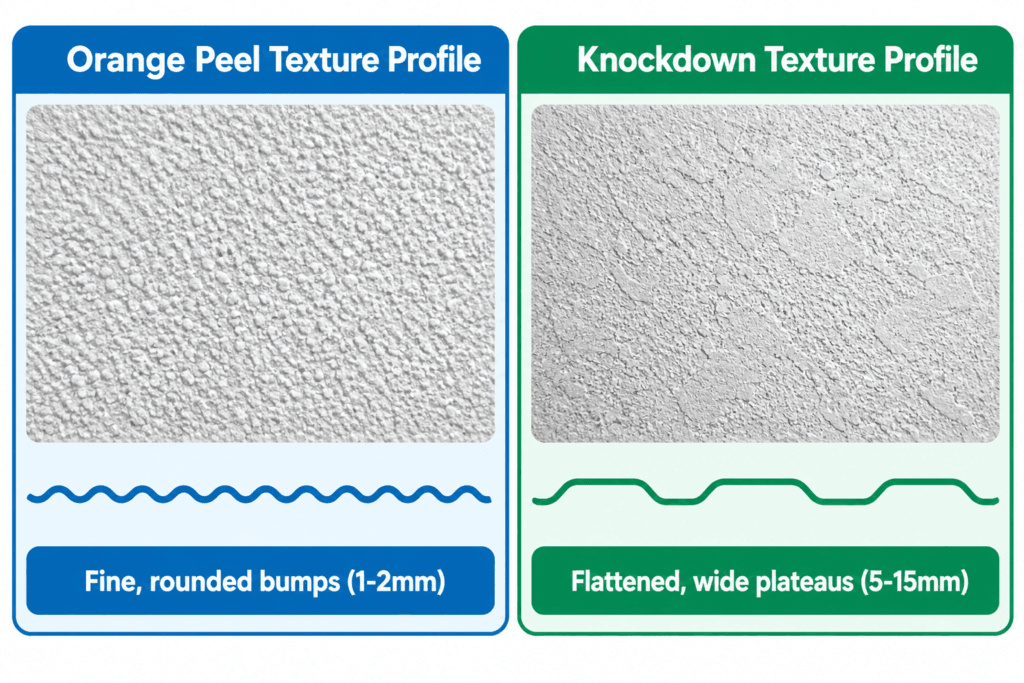
Texture Replication Technique:
| Texture Type | Application Tool | Compound Consistency | Application Technique |
| Orange Peel | Aerosol texture can / Hopper gun (small nozzle) | Thin, pancake-batter consistency | Spray in consistent 12-inch circular passes from 18 inches away. Allow to dry completely before priming. |
| Knockdown | Hopper gun (medium/large nozzle) + 18″ Flat Knife | Medium, pudding consistency | Spray splatter dots evenly across the patch. Wait 1 to 3 minutes for dots to lose their wet sheen, then lightly skim across the surface with an 18-inch drywall knife held at a 15-degree angle. |
Preventing Texture Flashing:
Therefore, never apply wall paint directly over bare drywall joint compound. Because of this, the porous mud absorbs paint resin faster than the surrounding painted surface, creating a dull spot known as “flashing.” Always apply a dedicated acrylic latex stain-blocking primer over repairs before applying topcoat paint.
Cabinetry, Hardware & Mechanical Maintenance for Southwest Florida Home Care
Coastal kitchens and bathrooms require specialized attention to prevent hinge failure and structural swelling caused by salt air and moisture. Routine hardware care is an essential component of professional Southwest Florida Property Maintenance for coastal kitchens and bathrooms.
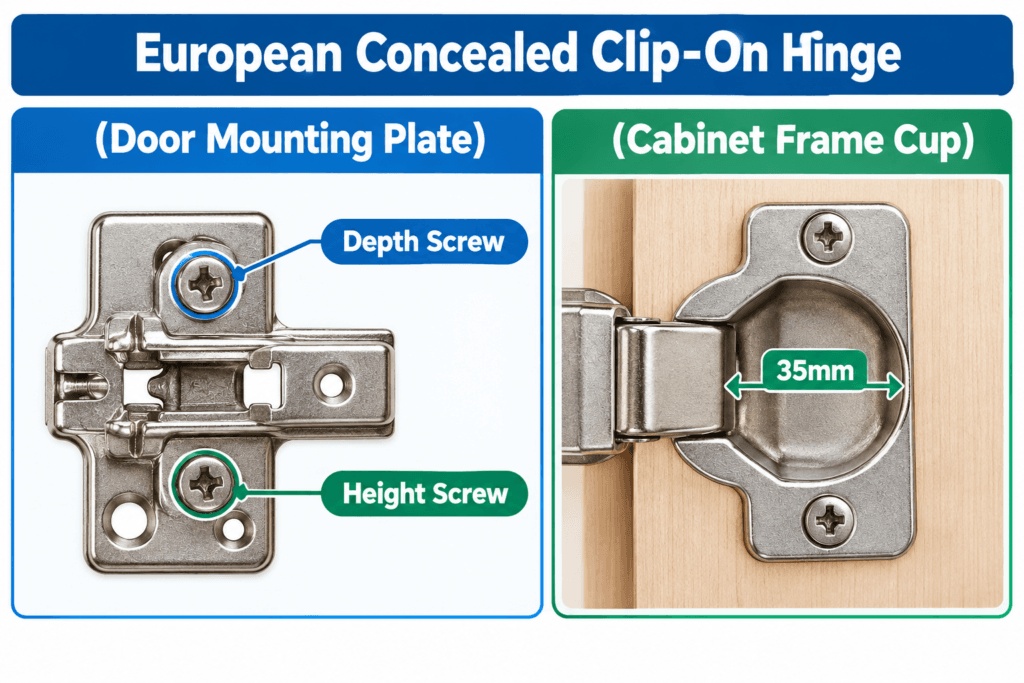
European Cabinet Hinge Adjustment & Corrosion Prevention
In fact, most modern SWFL kitchen and bath cabinets use 35mm European-style concealed hinges. Consequently, salt air can cause non-stainless concealed hinges to bind, squeak, or develop surface rust within months.
Adjustment Mechanics:
Side-to-Side Adjustment (Lateral): Turn the frontmost adjustment screw clockwise or counter-clockwise to shift the door panel left or right for even vertical gaps.
Depth Adjustment (In/Out): Turn the center rear screw to pull the door face flush against the cabinet box face, ensuring soft-close dampers engage smoothly.
Height Adjustment (Vertical): Loosen the mounting plate base screws, shift the door assembly up or down to align with adjacent doors, and retighten firmly.
Corrosion Protection: Spray hinge pivot points biannually with a dry-film PTFE silicone lubricant. Avoid heavy oils or WD-40 multi-use sprays, which attract dust, sand, and pet hair.
Pool, Spa & Outdoor Living Area Care for Southwest Florida Property Maintenance
Lanais, screen enclosures, and pool heating systems represent significant capital investments that require routine seasonal care. Proper care for lanais and pool equipment keeps outdoor spaces functional as part of your overall Southwest Florida Property Maintenance routine.
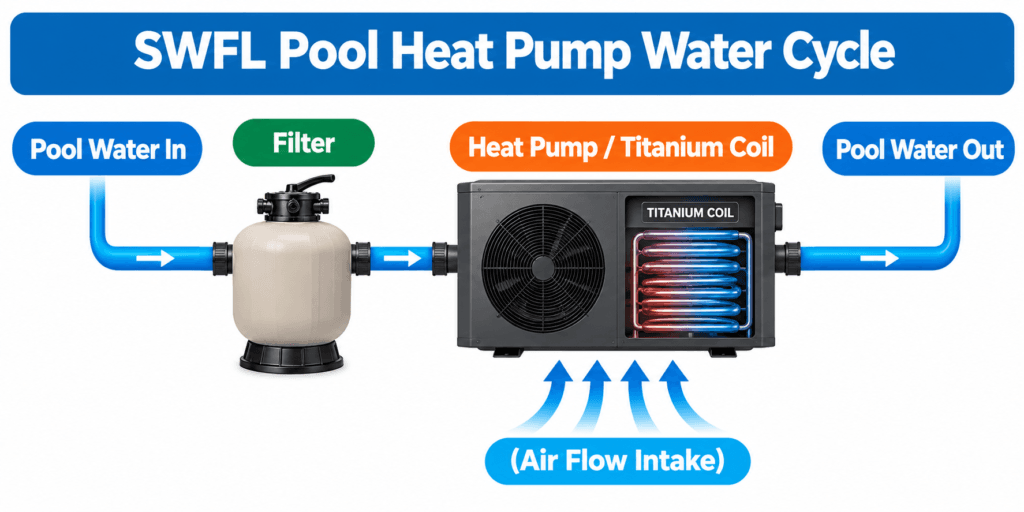
Pool Heat Pump Sizing & Low-Voltage Integration
Home pools need strong electric heat pumps built with tough metal parts to withstand harsh pool chemicals and salt-chlorine generators.
Heat Pump BTU Sizing Guide:
10,000 – 14,000 Gallon Pools: Minimum 90,000 to 110,000 BTU unit.
15,000 – 22,000 Gallon Pools: Minimum 120,000 to 140,000 BTU unit.
Thermal Blanket Integration: Utilizing a solar pool blanket during winter months (December through February) reduces evaporative heat loss by up to 70%, significantly lowering heating costs.
Low-Voltage Remote Controls:
Modern pool heaters link directly to indoor or smartphone automation controllers via low-voltage 2-wire RS-485 or dry-contact control circuits. Ensure all low-voltage connections at the heat pump terminal board are coated with dielectric grease to prevent corrosion from humid outdoor air.
The Season-by-Season Southwest Florida Property Maintenance Care Calendar
Sticking to a quarterly schedule is the best way to stay ahead on routine Southwest Florida Property Maintenance tasks year-round. Keep your property performing at its peak year-round by following this structured quarterly schedule:
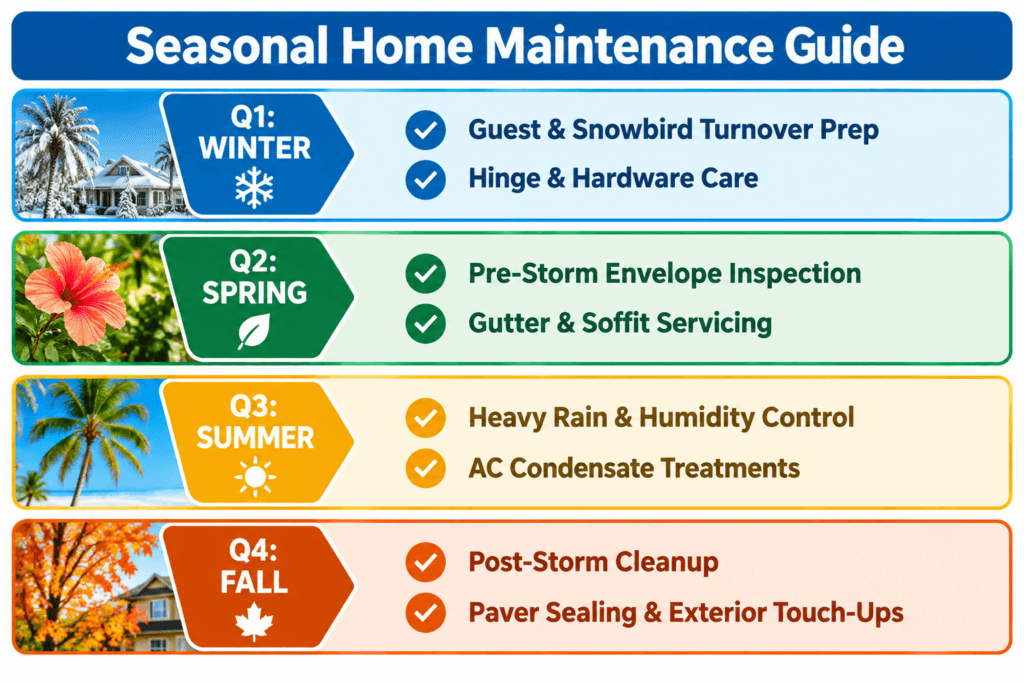
Q1: Winter (January – March) | Peak Season Operations
Inspect lanais, pool cages, and door locks between guest turns or during owner visits.
Additionally, clean and adjust European cabinet hinges; apply dry PTFE lubricant to sliding door tracks.
Monitor pool heat pump operation and check chemical balances weekly during heavy pool use.
Q2: Spring (April – June) | Pre-Storm Preparation
Inspect stucco walls for hairline cracking; apply elastomeric sealant to suspect areas.
Clean gutters, clear downspouts, and verify water diverters run 3+ feet clear of foundations.
Service the HVAC unit: change air filters, treat condensate lines with vinegar, and flush outdoor condenser coils with freshwater to remove accumulated salt crust.
Q3: Summer (July – September) | Rainy Season & Humidity Defense
Verify HVAC settings for vacant periods (76°F–78°F, Fan AUTO, humidity set below 55%).
Inspect soffit panels and fascia returns after heavy summer thunderstorms for sagging or displacement.
Check perimeter drainage pop-ups and canal outfalls to ensure rain runoff drains freely without pooling near the home.
Q4: Fall (October – December) | Post-Storm Assessment & Maintenance
Conduct a full exterior envelope inspection following the close of hurricane season (Nov 30).
Pressure wash driveways, lanais, and walkways to strip away accumulated summer algae and mold.
Inspect window seals, sliding glass door weatherstripping, and exterior light fixtures for weather tightness.
Downloadable Southwest Florida Property Maintenance
Checklist (PDF)
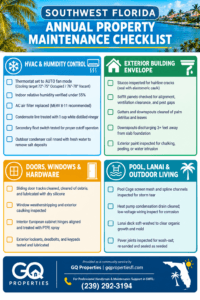
To help hosts, property managers, and owners keep their homes guest-ready year-round, we’ve created a printable single-page PDF maintenance checklist.
📥 Click Here to Download the Free SWFL Home Care & Turnover Checklist (PDF)
Need Local, Reliable Handyman Support in Southwest Florida?
Ultimately, maintaining a home or vacation rental from afar can be overwhelming. Therefore, GQ Properties provides dependable, high-quality handyman and property maintenance services tailored to the unique demands of Southwest Florida real estate.
From drywall patching and soft washing to soffit repairs, gutter clearing, and pre-season turnover prep, we treat your home with the care and attention it deserves.
Choosing a local expert like GQ Properties means you get:
- ✅ Knowledge of Florida’s climate and building challenges
- ✅ Faster response times
- ✅ Cost-effective solutions
- ✅ Reliable, professional service
When you need professional Southwest Florida Property Maintenance, partnering with a trusted local team ensures your home stays in top condition. We understand the specific needs of homes in coastal and inland Florida communities.
At GQ Properties, we take the stress out of home repairs by handling your property repairs quickly, correctly, and professionally. We proudly serve homeowners and property managers throughout our local communities, including:
Let us take care of your property maintenance needs.
📞 Call: 239-292-3194
📧 Email: services@gqpropertiesfl.com
📝 Request a quote online
GQ Properties — Your Trusted Handyman in Southwest Florida
Useful External Resources for Florida Homeowners
Review current regional structural standards and updates at the Florida Building Code Online.
Read official guidelines on moisture control and mold prevention from the Florida Department of Health.
- Learn about storm protection systems and consumer resources from the Florida Department of Financial Services.